
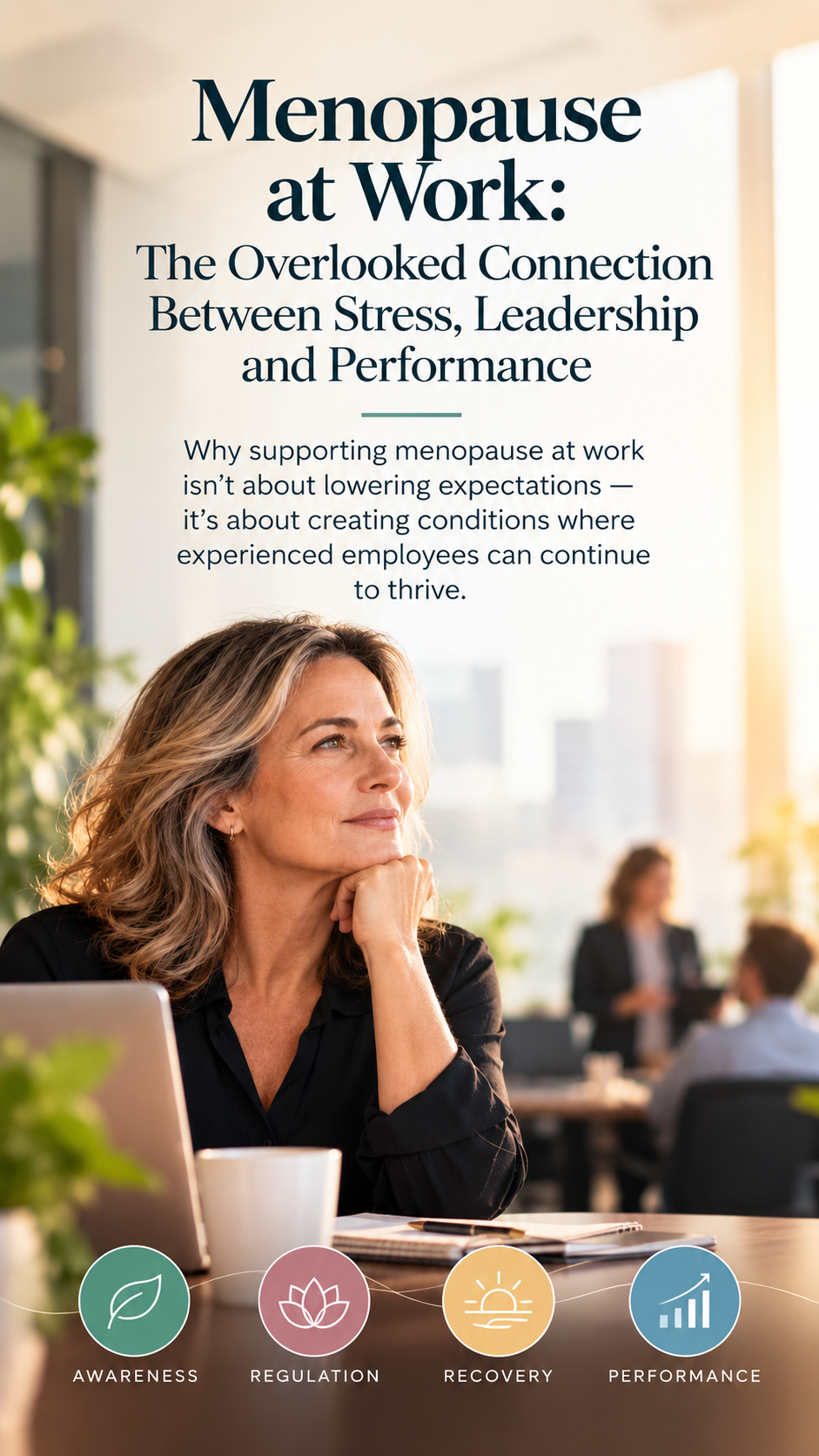
Why supporting menopause at work isn’t about lowering expectations — it’s about creating conditions where experienced employees can continue to thrive.
What if menopause isn’t exposing a problem with women’s performance, but revealing something about how organisations manage workplace pressure?
An experienced employee starts finding her working day more demanding.
She’s still capable. Still committed. Still bringing years of expertise and knowledge to the organisation.
But something has changed.
Perhaps she’s experiencing disrupted sleep, fatigue or difficulty concentrating while navigating perimenopause or menopause.
The deadlines haven’t changed. The meetings haven’t changed. The expectations haven’t changed.
But the effort required to meet them has.
And here’s where leadership decisions become important.
Do we immediately question the employee’s performance, or do we examine the pressure surrounding it?
Because those are two very different conversations.
The overlooked connection between menopause and workplace stress
Menopause doesn’t happen in isolation from the working environment.
A woman experiencing disrupted sleep may find it harder to recover from an already demanding working day.
Someone managing fatigue may need additional effort to maintain concentration through consecutive meetings.
And an employee navigating fluctuating symptoms may find that familiar workplace demands now require different strategies.
Not every woman experiences these difficulties. Menopause is highly individual, and many women continue working without significant disruption.
But for those who do experience symptoms, workplace conditions can influence how manageable their working day feels.
This raises an important question:
Are we measuring someone’s ability to perform, or their ability to absorb pressure without showing its effects?
There’s a difference.
An employee may remain highly capable while needing adjustments to how work is organised.
Yet in workplaces where constant availability, long hours and uninterrupted productivity are treated as measures of commitment, asking for support can feel professionally risky.
Sometimes the issue isn’t a lack of capability.
It’s the interaction between changing individual needs and workplace expectations that haven’t evolved.
When resilience becomes the wrong answer to the right problem
For more than three decades, I’ve worked with people through yoga, meditation and practical approaches to stress management and wellbeing.
I believe strongly in helping people recognise pressure, regulate their responses and develop sustainable recovery practices.
But there’s an important distinction between building resilience and expecting people to tolerate preventable pressure.
A breathing technique may help someone manage an immediate stress response.
It cannot resolve an unreasonable workload.
Mindfulness may help someone recognise when pressure is building.
It cannot compensate for a workplace where employees feel unsafe requesting support.
Recovery practices may help restore energy.
But their benefits can be undermined when workloads and working patterns leave little opportunity for recovery.
Resilience should help people navigate pressure. It should never become an excuse for organisations to leave harmful pressure unchanged.
This is particularly relevant when discussing menopause at work.
The answer cannot simply be to help women cope better.
We also need to examine whether workplace expectations are creating unnecessary demands.
The performance paradox: Are we confusing consistency with capability?
Businesses need accountability, reliable outcomes and effective performance.
But does achieving consistent results require everyone to work in exactly the same way?
Consider two experienced professionals.
One is sleeping well and managing a predictable workload.
The other is experiencing interrupted sleep and fatigue while navigating menopause.
Both may be capable of delivering valuable work.
But expecting identical working patterns without considering individual circumstances can create avoidable barriers.
This isn’t about lowering standards.
Flexibility in how work gets done can sometimes protect consistency in what gets delivered.
Appropriate adjustments, greater control over scheduling and supportive management can help employees continue contributing effectively.
And that’s not simply a wellbeing consideration.
It’s a leadership and business performance decision.
Why recovery deserves more attention in workplace wellbeing
Organisations measure productivity, efficiency, engagement and results.
But how often do they examine whether the way work is organised allows people to recover from sustained demands?
Recovery is frequently treated as something employees should manage outside working hours.
Yet workplace demands directly influence fatigue, stress and opportunities for restoration.
For someone already experiencing disrupted sleep or fluctuating energy, this relationship can become particularly important.
This raises broader questions about workplace culture.
Are back-to-back meetings always necessary?
Are workloads reasonable?
Can employees take meaningful breaks?
Do managers recognise when sustained pressure is affecting their teams?
And perhaps most importantly:
Are we rewarding effective performance, or simply rewarding the appearance of constant availability?
Menopause doesn’t create every workplace problem.
But it can reveal existing weaknesses in how organisations manage pressure, flexibility and recovery.
From menopause awareness to meaningful workplace action
Menopause awareness campaigns play an important role in reducing stigma and encouraging conversation.
But awareness alone doesn’t change the everyday experience of work.
For HR Directors, People & Culture leaders and CEOs, three leadership shifts deserve attention.
1. Move from assumptions to conversations
A change in someone’s energy or performance should not automatically be attributed to menopause.
Nor should employees feel obligated to disclose private medical information.
Managers need to create respectful opportunities to discuss workplace needs, understand what support may help and involve appropriate HR or health professionals when necessary.
2. Move from coping strategies to managing workplace pressure
Stress-management training can be valuable.
But organisations must also identify and manage psychosocial hazards such as excessive job demands, inadequate support and poor organisational practices.
Individual resilience and organisational responsibility should work together.
One cannot replace the other.
3. Move from constant availability to sustainable contribution
Being available for every meeting, responding immediately to every request and working long hours are not necessarily indicators of effective performance.
Leaders should consider whether expectations are genuinely connected to outcomes or simply reflect established workplace habits.
Practical adjustments and greater flexibility may help employees maintain their contribution while managing changing needs.
The real measure of progress isn’t how often an organisation talks about menopause. It’s whether its workplace practices make a meaningful difference.
Building sustainable performance through awareness, regulation and recovery
At My Wellness Journey, our approach to workplace stress resilience is built around four connected principles:
Awareness · Regulation · Recovery · Performance
These principles underpin our Calm Under Pressure™ framework.
Awareness helps people recognise when pressure is building.
Regulation provides practical approaches for managing everyday stress responses.
Recovery recognises the importance of restoring energy and preventing sustained pressure from accumulating.
Performance considers how people can continue contributing effectively without continually sacrificing their wellbeing.
These capabilities are not treatments for menopause, nor can they replace appropriate healthcare or workplace adjustments.
And they cannot operate independently of organisational culture and leadership.
A person may learn effective stress-management techniques yet still struggle in an environment characterised by excessive demands and insufficient support.
That’s why sustainable performance requires both individual capabilities and organisational action.
Menopause provides an important opportunity to examine how well those two elements are working together.
The leadership question we need to ask
We often admire employees who keep delivering despite fatigue, pressure and competing responsibilities.
We describe them as committed, adaptable and resilient.
But what happens when continually pushing through becomes the standard against which everyone is measured?
What happens when experienced employees feel they must conceal their difficulties to protect their professional credibility?
And what does that reveal about the organisation’s understanding of performance?
A genuinely resilient workplace shouldn’t depend on employees continually exceeding their capacity to keep things running.
It should create conditions where people can contribute effectively, access appropriate support and recover from demanding work.
Supporting menopause at work isn’t about lowering expectations.
It’s about recognising that sustainable performance depends not only on what employees can do, but also on the conditions in which they’re expected to do it.
And that leaves us with one question worth taking into the next leadership meeting:
If your most experienced employees can only maintain their performance by continually pushing through fatigue and pressure, are you building a resilient workforce — or relying on a fragile way of working?
Strengthen workplace stress resilience with My Wellness Journey
My Wellness Journey works with Australian organisations to strengthen workplace wellbeing, stress resilience and sustainable performance.
Our Calm Under Pressure™ program helps teams develop practical capabilities in awareness, regulation, recovery and performance, alongside the importance of supportive workplace practices.
Explore our Corporate Wellbeing Programs to discuss practical approaches for your organisation.