
Workplace wellbeing has become one of the most talked-about topics in modern organisations.
Employers are investing in wellbeing programs, resilience training, mental health initiatives and employee support resources. Yet despite these efforts, many workplaces continue to experience rising levels of stress, burnout, disengagement and fatigue.
Why?
Perhaps the challenge is not a lack of wellbeing initiatives.
Perhaps the challenge is that we have become highly skilled at managing time while paying far less attention to managing human energy.
As workplaces face increasing demands, rapid technological change, AI-driven disruption and ongoing uncertainty, understanding the relationship between energy, recovery, attention and performance may be one of the most important workplace wellbeing strategies of our time.
Why Workplace Wellbeing Requires More Than Time Management
For decades, productivity has been viewed through the lens of efficiency.
We optimise schedules, calendars, meetings and workflows. We look for ways to do more in less time.
Yet people are not machines.
Unlike technology, human beings do not operate at a constant level of performance throughout the day. Energy naturally fluctuates. Mental clarity rises and falls. Attention shifts. Motivation changes. Stress accumulates.
Many employees spend their days moving from meeting to meeting, responding to emails, managing competing priorities and navigating constant interruptions. Over time, this can create a significant drain on cognitive and emotional resources.
When people continually push through fatigue without opportunities for recovery, performance begins to suffer.
This often shows up as:
Reduced concentration
Poor decision-making
Increased mistakes
Lower creativity
Emotional reactivity
Decreased engagement
Higher risk of burnout
The issue is not a lack of commitment.
The issue is often a lack of sustainable energy management.
Recovery and Burnout Prevention in the Workplace
One of the biggest misconceptions about workplace wellbeing is that recovery simply means taking annual leave or getting more sleep.
While both are important, recovery is much broader than rest.
Recovery occurs when employees have opportunities to replenish physical, mental and emotional resources before stress becomes chronic.
In practical workplace terms, recovery may include:
Taking meaningful breaks between demanding tasks
Creating moments of mental quiet throughout the day
Moving regularly rather than remaining seated for hours
Spending time outdoors
Disconnecting from technology after work
Protecting boundaries between work and personal life
Building routines that support long-term wellbeing
Without adequate recovery, stress accumulates.
Employees may continue functioning and meeting deadlines, but often at the cost of increased fatigue, reduced resilience and diminished performance.
From a workplace wellbeing perspective, recovery should not be viewed as a reward for hard work.
It should be viewed as a necessary component of sustainable performance.
Managing Attention and Focus in the Modern Workplace
In today’s workplace, attention has become one of our most valuable resources.
Employees are navigating a constant stream of emails, notifications, messages, virtual meetings, information and AI-generated content.
The challenge is no longer access to information.
The challenge is managing attention.
Research continues to show that frequent interruptions reduce productivity, increase cognitive fatigue and make deep thinking more difficult.
Yet many organisations continue to reward constant responsiveness rather than focused work.
Employees often feel pressure to be continuously available, even when doing so fragments attention and reduces effectiveness.
Supporting employee wellbeing requires more than helping people manage stress.
It also requires helping people protect attention, reduce unnecessary distractions and create space for focused thinking.
In a world of increasing complexity, attention may be one of the most valuable workplace skills employees can develop.
Why Sustainable Behaviour Change Is So Difficult
Most workplace wellbeing initiatives aim to encourage healthier behaviours.
Employees are encouraged to move more, manage stress, improve sleep, take breaks and prioritise wellbeing.
These are valuable goals.
However, behaviour change rarely occurs through information alone.
Most people already know what supports wellbeing.
The challenge is creating environments that make healthy behaviours possible.
Workload expectations, organisational culture, leadership behaviour and workplace norms all influence how employees behave.
For example:
Do leaders model healthy boundaries?
Are employees encouraged to take breaks?
Is after-hours communication expected?
Are workloads realistic?
Is recovery valued or viewed as unproductive?
Without addressing these underlying factors, even the most well-designed wellbeing programs may struggle to create lasting change.
Sustainable workplace wellbeing requires both individual responsibility and organisational support.
The Link Between Energy, Attention and Workplace Performance
Many organisations continue to focus heavily on productivity outcomes.
However, productivity is often the result of several interconnected factors.
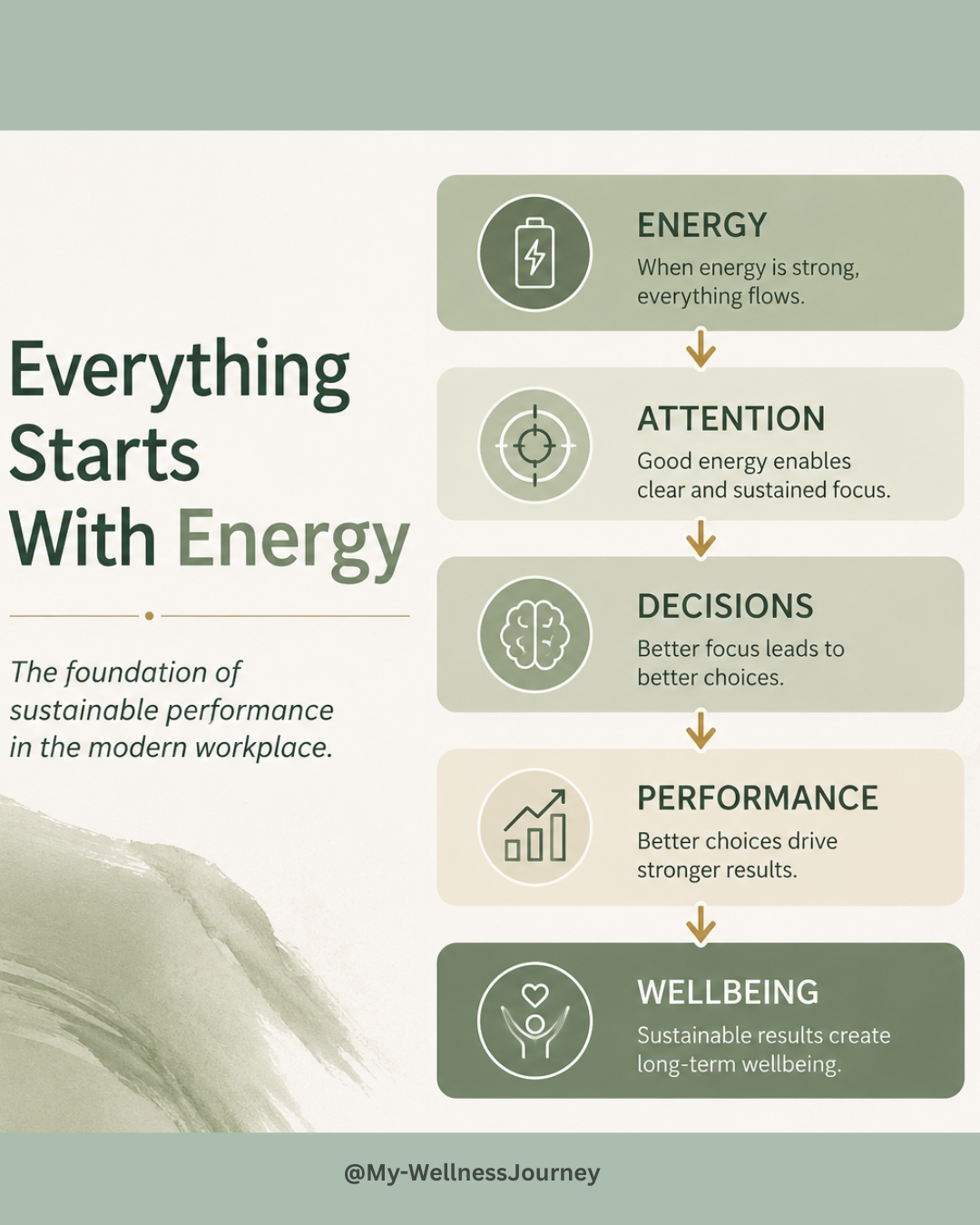
A useful way to think about workplace performance is:
Energy → Attention → Decisions → Performance → Wellbeing
When energy is depleted:
Attention becomes fragmented.
Decision-making quality declines.
Performance suffers.
Wellbeing deteriorates.
When energy is supported:
Focus improves.
Decisions become clearer.
Performance becomes more sustainable.
Wellbeing strengthens.
This shift in perspective encourages organisations to look beyond productivity metrics and consider the underlying conditions that enable people to perform well.
Sustainable Performance in a High-Demand World
Today’s workplaces face significant challenges.
Rapid change.
Skills shortages.
Economic uncertainty.
Technological disruption.
Increasing psychosocial risk obligations.
Growing expectations on leaders and employees alike.
Many people are being asked to do more with less.
While short bursts of effort may sometimes be necessary, sustainable performance cannot be built on constant pressure.
High-performing individuals are not necessarily those who work the longest hours.
They are often those who understand how to manage energy effectively, recover consistently, maintain focus and adapt without exhausting themselves in the process.
This is where workplace wellbeing and business performance intersect.
Healthy employees are not simply happier employees.
They are often more focused, more resilient, more engaged and better equipped to navigate complexity and change.
A New Conversation About Workplace Wellbeing
The future of workplace wellbeing may not lie in doing more.
It may lie in understanding people more deeply.
When organisations recognise that energy is finite, recovery is essential, attention is precious and behaviour is shaped by environment, a different conversation begins to emerge.
Instead of asking:
“How can we get people to do more?”
We begin asking:
“How can we help people perform at their best without exhausting themselves in the process?”
That shift may be one of the most important leadership and workplace wellbeing questions of our time.
Because sustainable performance is not simply about getting through the next quarter.
It is about creating workplaces where people can thrive, contribute and perform well for years to come.
Could your team benefit from a more sustainable approach to performance and wellbeing?
I work with organisations across Australia to deliver practical workplace wellbeing programs that help employees manage stress, build resilience and perform at their best.
→ Explore the Wellbeing Wisdom Library
or
→ Request a Corporate Wellbeing Proposal